Startup Opportunity Exploration
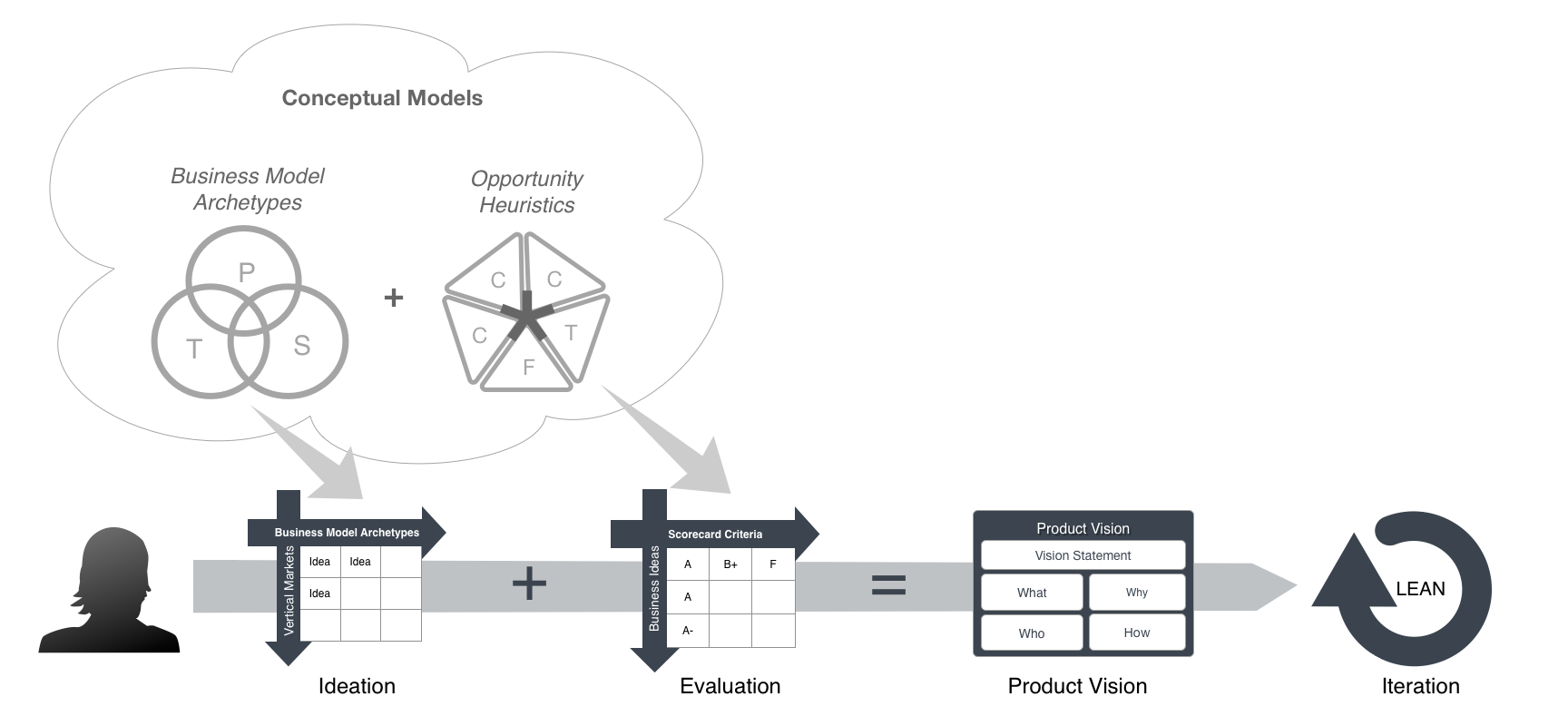
Sometimes people create a startup because they have an idea and they want to bring it to life. Sometimes, it goes the other direction and you know you want to create something but you don’t know where to start. When that’s the case, you might look at what already exists around you but those are problems that already have solutions, in most cases, unless you can differentiate those ideas. And taking a systematic approach to that ideation is often how you’ll uncover the most compelling opportunities — this article describes such a framework .
There are two primary steps to the process, driven by two of the conceptual models that we describe here – the Business Model Archetypes, and Startup Heuristics. Putting these two frameworks together, we have a comprehensive way to cover the possibilities. The goal is not to replace market validation but rather, to accelerate the creation of a short list of opportunities that you can use to actually do that validation work.
Note – the purpose of this framework is to identify net-new startup ideas, not to do more formal startup opportunity discovery for existing businesses or products. For that, please see this article on Opportunity Discovery.
Walking Through the Process
Step 1 – Ideation
In this first exercise we are going to make a list of vertical markets that we’re interested in serving. From an opportunistic perspective, you may want to weigh the options from several different verticals to see how they stack up. Or, if you already have deep investment or subject matter expertise in a particular vertical market, think instead of 3-5 roles within that broader vertical market that you could serve. For this example, I’m going to assume we are planning to go into the specific field of real estate. I’m going to consider serving a few different roles to begin:
• Real estate, agents
• Real estate brokers
• Property managers
Next, I’m going to create a matrix and place those roles that I may want to serve along the Y axis. I’ll place the 7 business model archetypes (fundamental types of businesses) across the X axis. My goal now is to think of ways that I could serve each of these three roles with a business that fits each of the 7 archetypes. If you’re not already familiar with the 7 business model archetypes, please review them so that you can apply this concept.
In reality, you may know at the outset that a handful of the models may not be a good fit, so you can cross those out from the beginning. For example, a software engineer may be very good at creating products but not as good at the act of trade and networking with suppliers and performing in-person sales, so they may choose to cross that out. And, you cannot expect to start by being an ecosystem business; that’s something you grow into and trying to be that from day one is going to spread your efforts too thin, so you can cross that out as well.
Once done, you should have a matrix that looks something like this: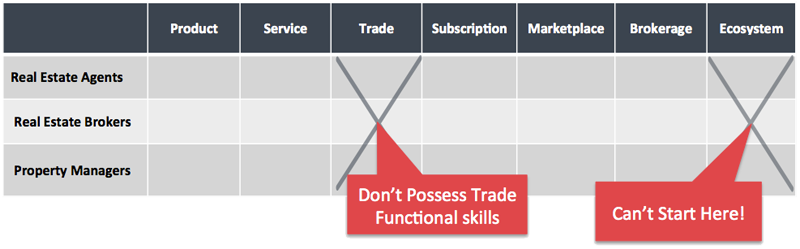
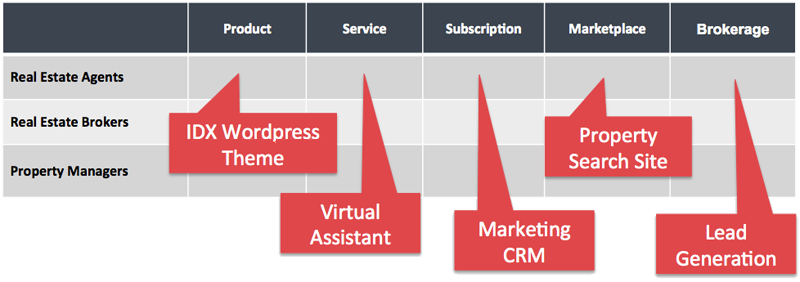
The next step is simply to fill in each section on the matrix, until you’ve come up with a way to serve each of these roles, with each of the business model archetypes. Here is an example:
Step 2 – Evaluation
Once you have come up with a grid of ideas, it is time to begin testing whether they are viable. To aid in this process, we’ll leverage the Startup Opportunity Heuristics, which is a collection of 18 startup principles that account for strategic strengths and vulnerabilities that you should be thinking about early on. By accounting for these things early on, and comparing ideas along the same criteria, you can improve your odds of success, by spending less time “pivoting” and less time chasing ideas that you could have anticipated were unlikely to succeed.
Our first adaptation of the Startup Heuristics is the Startup Opportunity Scorecard, which provides an easy instrument for grading an opportunity’s proficiency across 6 primary sections (3 heuristics per section):

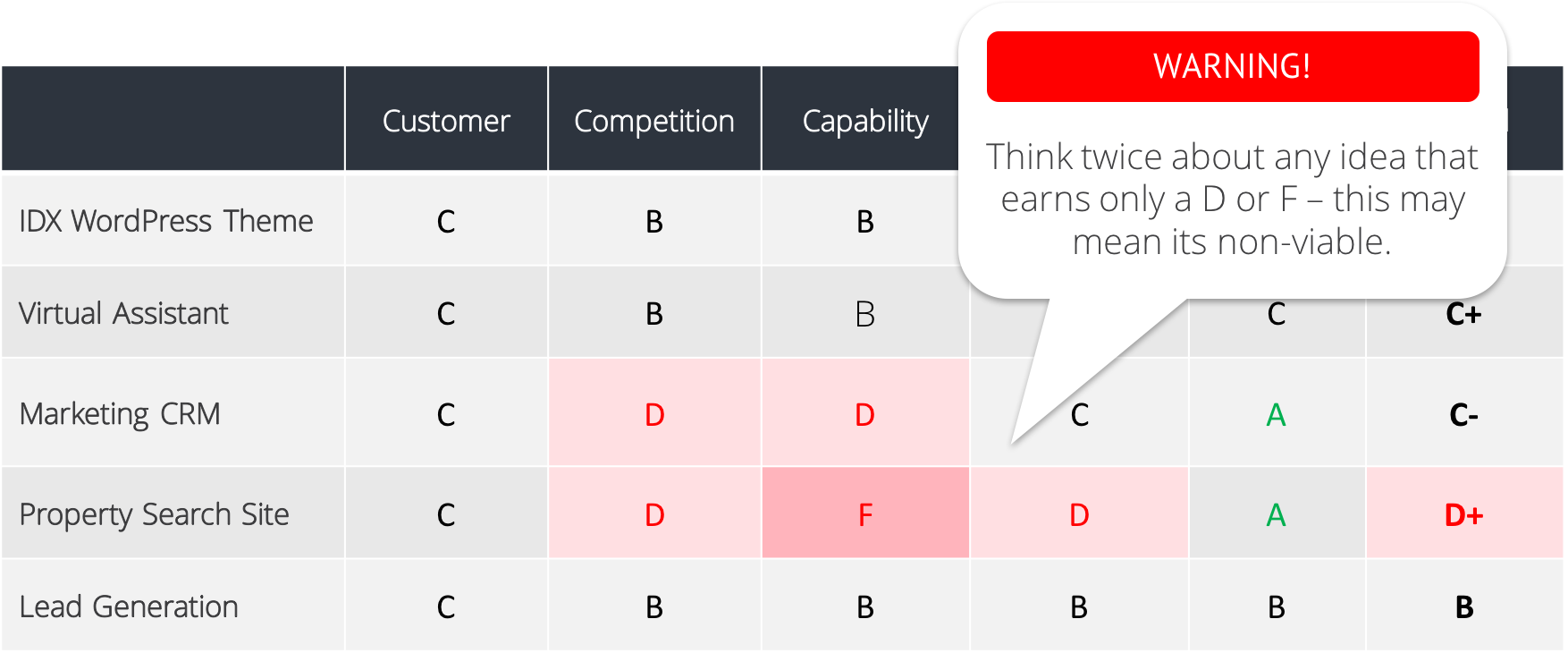
Next, we will compile a matrix that compares each idea that we’ve identified, grading each of the heuristics for that idea, so that we can clearly see how these ideas compare across these 5 dimensions, and where the strengths and weaknesses are:
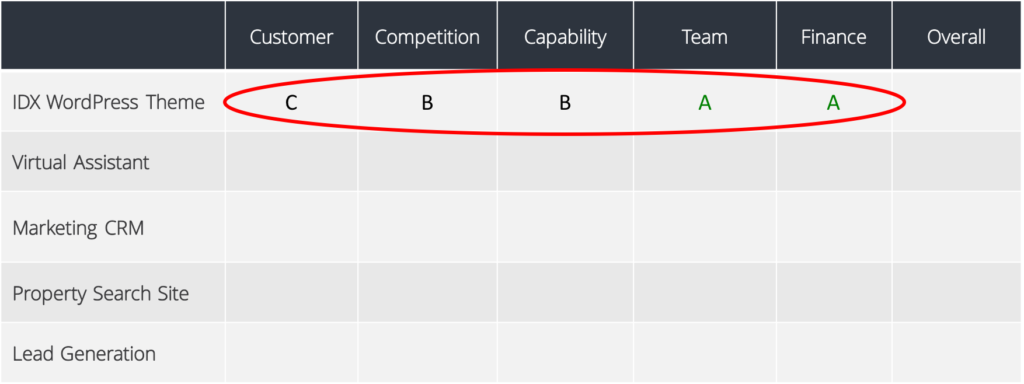
After you fill out the self-assessment grades for each idea, across each eligible archetype, take a closer look for anything that rated low (D or F). These are clear red flags and you probably shouldn’t proceed with an idea that has even a single D or F, unless you’re able to restructure the idea in such a way that it is more viable. And therein is one of the best parts about objectively grading an opportunity in this way early on – it can quickly surface challenges you might not have thought about, had you not been looking at it critically, and it may be something easily fixed, which could translate to real time and cost savings down the road.
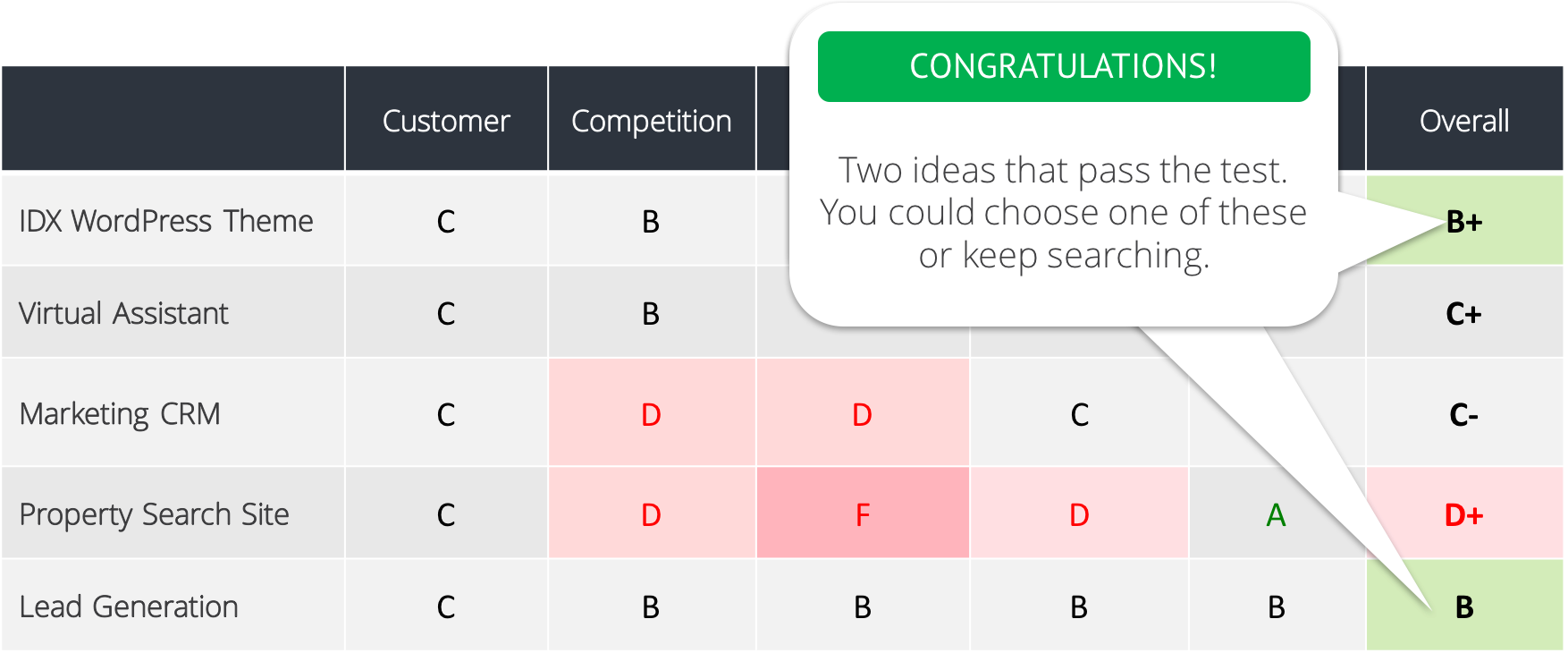
Now you’ll look at the overall score for each idea and pick the top 1-3 ideas that you can begin define at a deeper level and seek feedback for market fit.
Step 3 – Vision Definition
In the above example, it is really not clear that one idea is significantly stronger than another. In such a case, and assuming none of the ideas have any glaring holes (D or F score), you’d want to pursue the 2-3 ideas that are all in close proximity near the top, not just one. For the purposes of demonstration, however, we’re going to choose just one idea. We’re going to work through defining the idea more explicitly using the Startup Vision Definition worksheet that we’ve put together.
After you’ve spent the time to concisely identify answers to the key questions on the vision definition, the last step is to compose your 1-2 sentence vision statement, based upon the answers you’ve provided. You’ll want to answer the basic questions of what you’re building, who you’re building this for, why it’s of value to them, and how it will solve a problem for them in a differentiated way. B
Step 4 – Validation
It is finally time to begin validating the ideas/visions that you’ve come up with. You can start by sanity-checking the ideas with people around you to see if there is any early signal. If so, consider pushing forward to do a simple set of mocks/wireframes to more concretely demonstrate the idea and begin interviewing potential customers to get greater signal and start gathering feedback. After you’ve spoken to a dozen or so people, you’ll soon have a sense if there is any potential for the ideas. If you do find signal, then you can think about building a “minimal viable product” (MVP) to do further validation, but not before getting early signal based on lofi prototypes. This will keep you “honest” with the lean method, which is to do the minimum, work necessary to get a signal, to minimize waste and maximize potential outcome. If you can quickly test 5 ideas instead of building the first idea you think of, then you’ll significantly increase your odds of success.

Summary
The Startup Opportunity Exploration Framework is an applied set of tools based on the Business Model Archetypes and Startup Heuristics . The Ideation Matrix is a tool for identifying a way to service identified areas of interest, for each fundamental business model. Those ideas can then be graded against the 18 opportunity Heuristics, using the Startup Opportunity Evaluation Matrix. Ideas with significant flaws are discarded the top overall ideas are further developed into formal startup visions. The startup vision with a cohesive elevator pitch is the hypothesis you will then plug into the Lean process for validation. The goal of this process is to improve the efficiency with which a startup will arrive at market fit, by taking the time to understand market dynamics and to propose well thought out, informed hypotheses, and to avoid the risk of endless/aimless iterations and pivots that can otherwise happen, with a less diligent approach.