Startup Heuristics
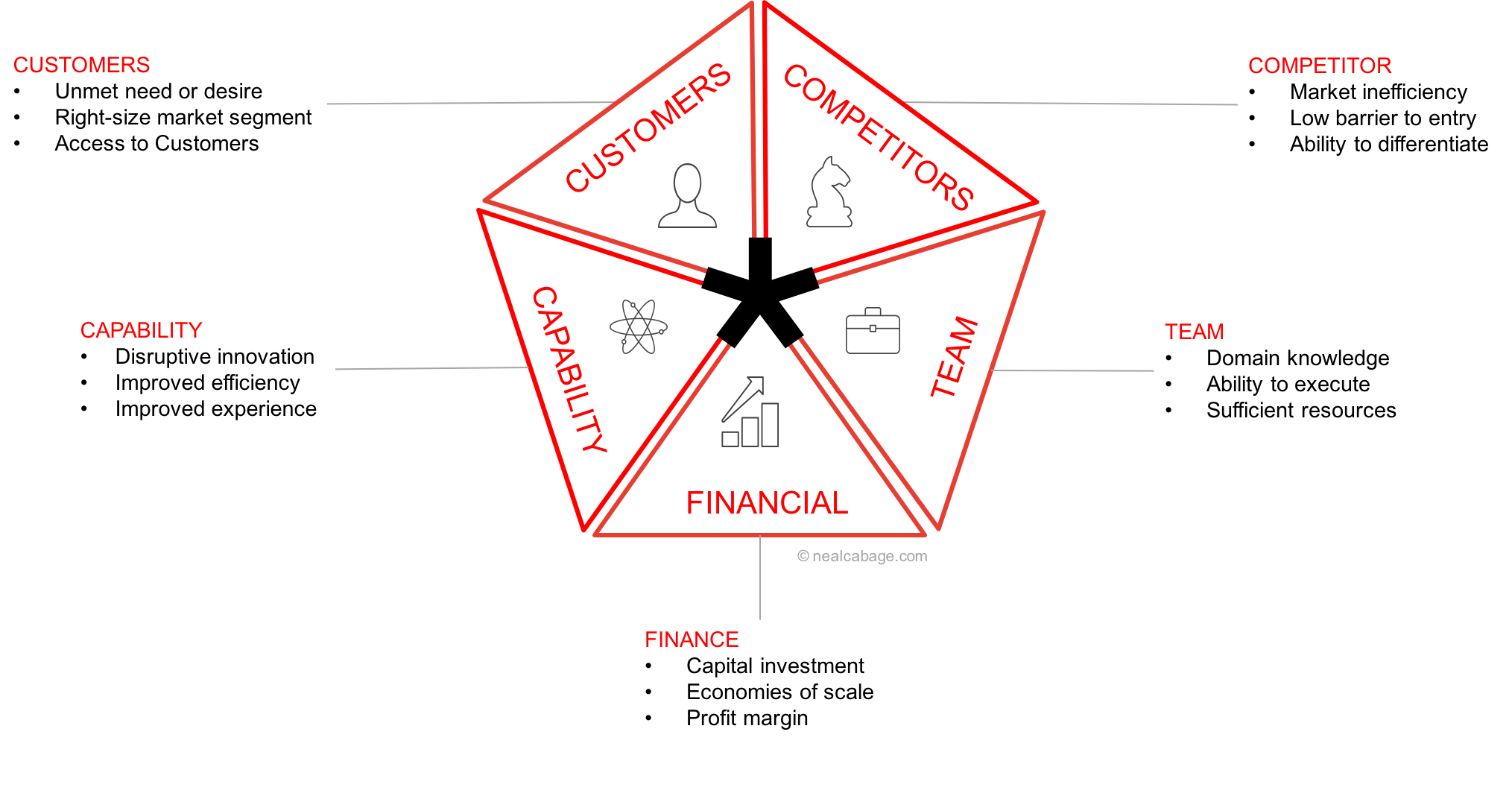
When you’re exploring new product or business ideas, the early stages are full of uncertainty and incomplete data. In situations like this, formal analysis is often impractical. That’s where heuristics — simple rules of thumb grounded in experience — can help you assess opportunities more intelligently and avoid common pitfalls.
Heuristics are commonly used in fields such as usability design, where they guide early decision-making before detailed testing. A similar set of principles can help startup founders and product teams think systematically about where to begin and where to invest effort first, before committing scarce resources.
This article describes a practical set of startup heuristics you can use to evaluate opportunity strength across key domains: Customer, Competition, Capability, Team, and Finance. These are not hard rules, but indicators that surface critical risks and potential advantages early in your discovery process.
Customer
Everything begins with the customer and seeking to understand what it is they need or desire that isn’t being sufficiently addressed by the market. As opportunities are identified, we can look at the size of the addressable market segment and the significance of that need or desire to determine if it is an opportunity we should pursue.
Customer Heuristics
1. Unmet Need or Desire – The best opportunities come from helping others. Find a need or desire that is not yet solved, where the customer is so passionate they’d happily pay for a solution. The challenge of following the money for a young startup is that if it can lead you into already mature (competitive) markets that are already saturated. If you’re early stage, you want to avoid such challenging market climates.
2. Right-Sized Market Segment – Select a market to service that meets your needs and abilities. You must have enough opportunity to warrant the effort. Be wary though of large markets, if you do not have significant funding or aggressive plans for growth.
3. Access to Customers – Are you able to identify reliable and diverse means by which to connect with your customers? You don’t want to be at the mercy of a single company who could decide to compete with you for access. Online publishers, for example, use to rely almost entirely upon Google for organic referrals (SEO). The companies that adapted and learned out to diversify through multiple social and paid acquisition channels proved more resilient.
Competition
Avoid being marginalized by excessive undifferentiated competition. That drives margin compression, commoditization, and market consolidation. Look for inefficient markets where there’s still ‘play’ and find ways to develop a sustainable competitive advantage.
Competition Heuristics
4. Market Inefficiency – In an optimally efficient market, a single competitor will become the dominant solution provider and command the large majority of opportunity and profit. Markets are inefficient when they’re new, fragmented for reasons such as geographic barriers or lack of discovery. An old stagnant market can be inefficient in other ways since it no longer provides an optimal solution and is ripe for disruption. Market inefficiency is the slack a startup needs to get a firm foothold.
5. Low Barriers to Entry – Avoid a fight you cannot win! A market can be much harder to enter if a competitor already has a mature offering that you’ll need to spend significant time and money catching up with in order to compete. You’ll also want to avoid any markets where a dominant competitor has already achieved economies of scale and can thus product cheaper products than you or can afford to acquire customers at a higher cost – they will use this leverage to increase their dominance and to eventually starve you out of the market.
6. Ability to Differentiate – An effective way to reduce competitive pressure, is to remove yourself from direct competition – you need to clearly identify a viable positioning strategy with this in mind. You may offer a similar solution but if you are not directly comparable then you are also not directly substitutable, meaning you will have some inherent advantage for a subset of the market. If you are early and develop economies of scale quickly, you can become the cost leader. In a more mature market you might focus on customizing a solution for a specific market segment’s unique needs, or your product might be inherently unique by focusing on a killer feature or user experience.
Capability
Every market has a natural lifecycle driven by innovation and circumstance. Look for new demand or interest in something that wasn’t possible just a couple years ago. Be a “fast follower” into a validated emerging market rather than speculating on new opportunities.
Capability Heuristics
7. Disruptive Innovation – Innovation can come in many forms. It can be new technology, or simply a new services program. The common thread is that it involves looking at the problem and finding a new and better way to solve the problem that differentiates your offering from your competition. In technology specifically, the adoption curve for new innovation is typically 10-12 years requires a relatively fast entrance in order to take advantage of the disruptive potential. For example, when the consumer Internet was really taking off in the mid-1990s, those early entrants were able to reach customers directly in a new and innovative way that differentiated them from traditional retailers. The same thing is happening with A.I. today. Eventually, these new technologies commoditize and become ubiquitous, however, at which point they’re no longer meaningfully differentiating – so timing is critical.
8. Improved Efficiency – By leveraging new capabilities, you can create new efficiencies that benefit both the business and the customer. For example, an e-commerce company might invest in Machine Learning (AI) to maximize the efficiency of inventory routing and placement throughout its distribution center network. This can create savings for the business as it allows customers to receive their orders much more quickly. Or, consider the ‘sharing economy’ model of Uber and AirBNB and how that has unlocked the ability to monetize the more expensive assets that often sit unused, and the value that has created for those who participate.
9. Improved Experience – Web 2.0, Web 3.0 (SoLoMo), and Artificial Intelligence are all recent examples of evolutions in digital product experience, through refined and more responsive interfaces, and infusion of new capabilities and content into way people interface with the applications. Early entrants who took advantage of these waves were able to step ahead simply by creating a better experience. For example, online dating was already thriving and incumbents were set by the end of Web 2.0. In Web 3.0, Tinder took advantage of the mobile and SoLoMo capabilities to transcend the incumbents and create a breakthrough new solution that surpassed the prior online dating market.
Team
Just because an opportunity exists, doesn’t mean your team is likely to succeed. Does your team have an inherent competitive advantage for the endeavor? Do you possess deep knowledge, technical skills to deliver, & access to key partners and resources?
Team Heuristics
10. Domain Knowledge – Does your team possess deep knowledge of the market you plan to enter? You’ll need to have a deep understanding of the market dynamics, the players within the market, and how to position yourself among these players. You also need an intimate understanding of the prospective customer and what they’re lacking so you know how to address their needs and desires. Without this expertise, you risk never finding market fit and never getting off the ground.
11. Ability to Execute – Understanding the customer and the market is not enough. Your team needs the technical competence to architect an effective solution and develop business relationships. Without this expertise, you risk not ever reaching scale or efficiency enough to maintain a competitive advantage.
12. Sufficient Resources– You can have the smartest and most capable startup founders but without resources to get started you’ll still face a significant uphill challenge. You need a team, an office, and capital to finance all the various expenses that go into building a business. Does your team have access to sufficient resources to have a reasonable chance at viability?
Finance
Look for opportunities to maximize returns without excess capital risk. Look for opportunities to start cheap and to realize higher margins through focused efforts and economies of scale. Avoid locking up too much capital.
Finance Heuristics
13. Capital Requirements – To build anything with potential to scale, there is a certain level of investment required to get it off the ground – that can be sunk costs for developing the product, working capital to float payroll and various licensing costs, or some combination of the two. Consider what the total capital burden is – is it reasonable? What is the return and risk profile for this capital investment? Is it a risk worth taking? Are there other investments that might make more sense from this financial point of view?
14. Economies of Scale – Look for opportunities where profits increase with volume (scale). Supply, development, and distribution costs all diminish on a per-unit basis when working in volume. As a result profit margin and competitive advantage both increase. Economies of Scale is a double-edged sword however – it is ideal from the perspective of achieving maximum returns but these opportunities are highly desirable and will attract many competitors, with significant investment. Note – If you have financial backing and a commitment to aggressive growth, economies of scale is a requisite part of that mandate. If you are bootstrapping or seek to build a lifestyle business, this can signal intense competition you may not be seeking.
15. Profit Margin – It is important to project your profit margin early on, for three reasons. The first is that it forces a certain clarity on what your profit and pricing models will be. The second is that it’s a good exercise in considering the true costs of offering the service and ensuring there is a reasonable profit to be made and the scale you’ll need to begin turning a profit. The third is that a healthy profit margin can indicate a relatively less competitive environment for which timing is good for entry. Conversely, thin margins may be indicative of an already competitive market that may not be conducive to entry.